
My Journey with Achilles Tendon Pain
This is another condition I’ve had to deal with over the years, and like many people, it didn’t start with a dramatic injury — just a small warning sign. I was finishing a run uphill when I felt a sharp little twinge in my Achilles. Nothing major at first, but it became one of those annoying issues that kept popping up whenever I pushed my legs a bit harder.
After a heavy gym session, especially leg day, the tendon would flare again. Standing at work for long stretches didn’t help either. My solution back then was to go out and buy another pair of Rockport shoes for more ankle stability. They helped… for a while. But then the same pattern kept repeating. The shoes would wear down on the inside of the ankle, the support would go, and the Achilles pain would return. I got sick of the cycle — new shoes, short-term relief, pain again.
Touch wood, I haven’t had Achilles pain for a long time now.
So what changed?
The answer was proper loading.
Not light calf raises. Not high reps. Not bodyweight-only strengthening.
I started doing weighted calf raises with a kettlebell — slow, deliberate, heavy loading. I began with 14 kg and worked my way up to 22 kg. The difference was night and day. My calf strength increased, my tendon capacity improved, and the Achilles stopped complaining.
In my experience, one of the main reasons patients fail to progress with Achilles rehab is that they stay stuck doing bodyweight calf raises, usually at high repetitions. It feels “safe,” but it doesn’t provide the mechanical stimulus needed for tendon adaptation. Tendons need load — real load — to remodel and get stronger.
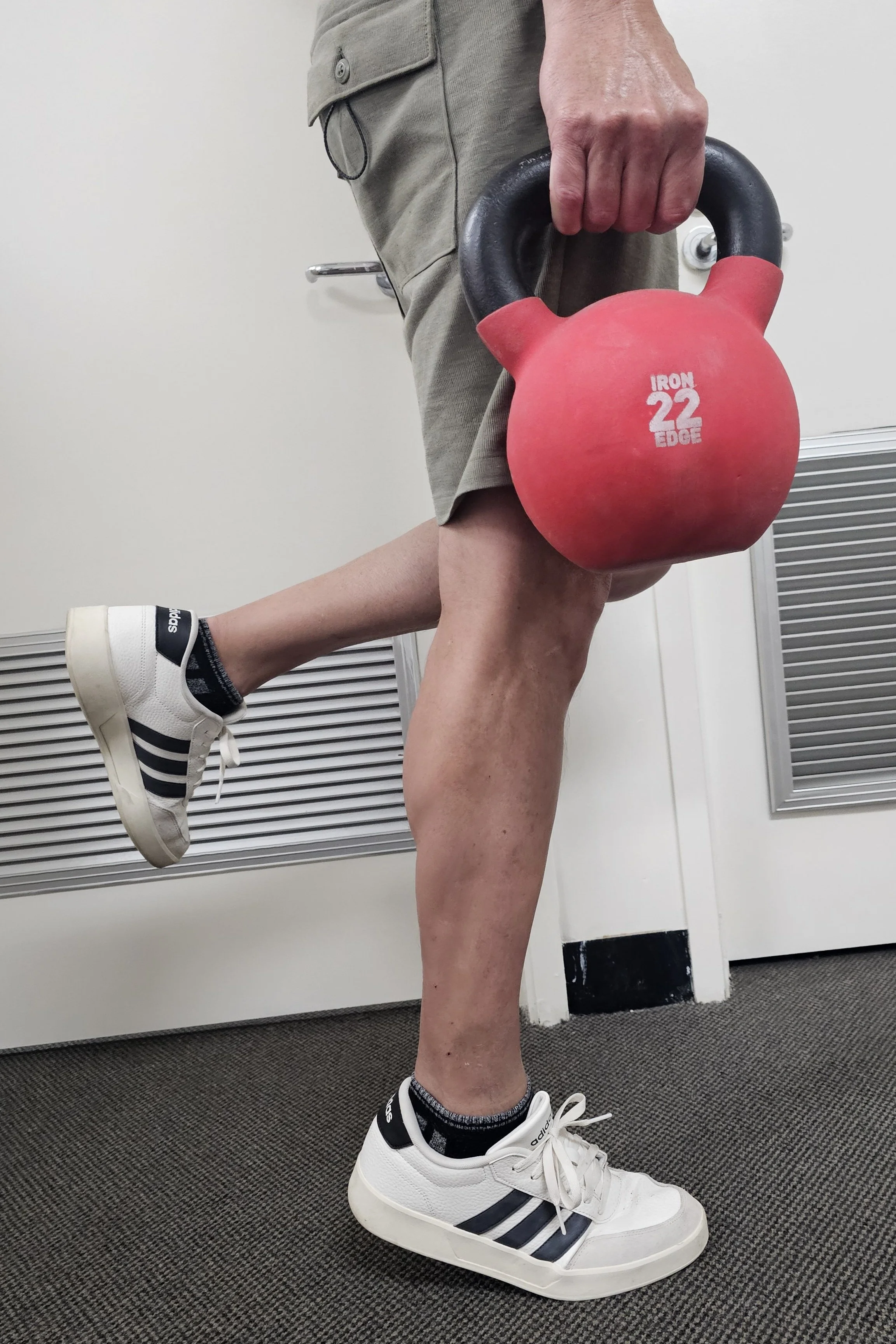
A German research group has described this clearly:
heavy, slow resistance is the most effective way to stimulate tendon adaptation, recommending something like 5 sets of 4 reps at around 90% maximal contraction for optimal tendon loading.
It’s not glamorous and it’s not easy… but it works.
And for me, it broke the cycle of flare-ups, worn-out shoes, and frustration.
