
My Weirdest Injury Ever
My Weirdest Injury Ever
My weirdest injury ever happened when I decided to start playing tennis again after a 20-year hiatus.
In my earlier years, I played at a high level and even coached junior tennis to help pay my way through university in Sydney and Adelaide. While I expected to be rusty, I didn’t expect what happened next.
My hitting partner was also a strong player, and from the start I struggled to put any real weight on the ball — let alone control points the way I used to. We settled into a nine-game set, and interestingly, the scores stayed close.
But as we reached the pointy end of the set, something strange began to happen.
When Power Just Disappears
My serving arm speed gradually dropped. There was no pain at all — just an overwhelming sense of fatigue. But it was more than that.
I simply could not generate power.
Eventually, I had to stop playing. My arm felt heavy, and lifting my shoulder to place my hand on the steering wheel to drive home was difficult. It felt profoundly abnormal.
So what was going on?
A Clue From Overhead Sports
Over the years, I’ve completed extensive continuing education in shoulder conditions, particularly in the athletic and overhead sports field. Many of the leading experts in this area come from the United States, working with baseball pitchers and throwing injuries.
One clinician whose work stood out to me is Mike Reinold. In baseball, there is a recognised condition where pitchers experience a sudden drop in throwing velocity without pain.
It’s known as Dead Arm Syndrome.
What Is Dead Arm Syndrome?
Dead Arm Syndrome is a condition that affects the brachial plexus — a bundle of nerves that originates in the neck and controls movement and power in the shoulder, arm, and hand.
Athletes with Dead Arm often report:
Sudden loss of speed or power
A heavy, unresponsive arm
Poor coordination
Minimal or no pain
Sound familiar?
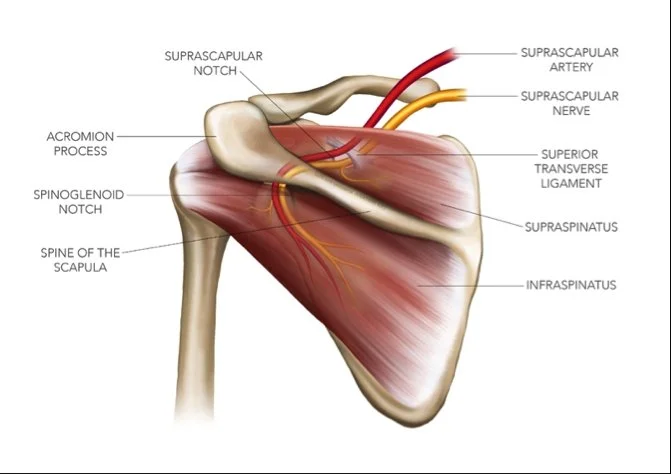
Suprascapular nerve part of the Brachial Plexus
Why Does Dead Arm Occur?
We don’t yet know the exact mechanism behind Dead Arm, but several well-supported theories exist.
During high-velocity throwing or serving, extreme arm speed creates traction forces on the nerves of the brachial plexus. Repeated or excessive traction can lead to a condition called neuropraxia — a temporary block in nerve conduction to the muscles.
When this happens, the brain sends the signal to move, but the message doesn’t get through effectively. The result is loss of power rather than pain.
This nerve stress may be influenced by:
Poor conditioning, particularly after time away from sport
Excessive shoulder movement or micro-instability, increasing nerve stretch
Fatigue of the rotator cuff and scapular stabilisers
Trying to generate too much power too quickly
In my case, it was almost certainly poor conditioning, combined with trying to hit the ball harder than my shoulder was ready for.
What It Felt Like
It was one of the strangest sensations I’ve ever experienced — almost like a stroke.
My mind was telling my arm to move, but it simply wouldn’t respond.
Recovery and Treatment
For me, the solution was simple: rest.
It took around two weeks before I was able to return to the court. Since then, I’ve made a full recovery and haven’t experienced another episode in over four years.
For others, particularly if Dead Arm occurs repeatedly, treatment may involve:
Assessing shoulder stability
Strengthening the rotator cuff
Improving scapular stabiliser endurance
Reducing excessive shoulder movement
Gradually rebuilding serving and overhead load
The goal is to improve control and reduce traction forces on the brachial plexus.
Final Thoughts
Dead Arm Syndrome is unusual, unsettling, and often misunderstood. Because it doesn’t present with pain, it’s easy to dismiss — but it reflects a real limitation in how the shoulder and nervous system are functioning under load.
If you’ve experienced a sudden loss of power, a heavy arm, or a shoulder that “just won’t work” during sport, we can assess what’s going on and guide your recovery.
