
Surgery is not The Only Way To Manage Carpal Tunnel Symptoms
Carpal Tunnel Syndrome: Why Nerve Compression is Only Part of the story
Why this matters for understanding carpal tunnel syndrome
If you've ever experienced numbness, tingling or pain in your thumb, index and middle fingers, you've probably heard someone say, "It's just carpal tunnel."
While carpal tunnel syndrome (CTS) is one of the most common nerve conditions we treat at Bacchus Marsh Physiotherapy, research over the past decade has changed how we understand and manage it.
The traditional belief was simple: the median nerve becomes compressed inside the carpal tunnel, causing pain and numbness.
While this is certainly true, we now know that compression is only one part of the story. Inflammation, nerve movement, tendon health, general health and even how the nervous system processes pain can all influence your symptoms.
Understanding these factors explains why many people improve with physiotherapy and why surgery isn't always necessary.
What is carpal tunnel syndrome?
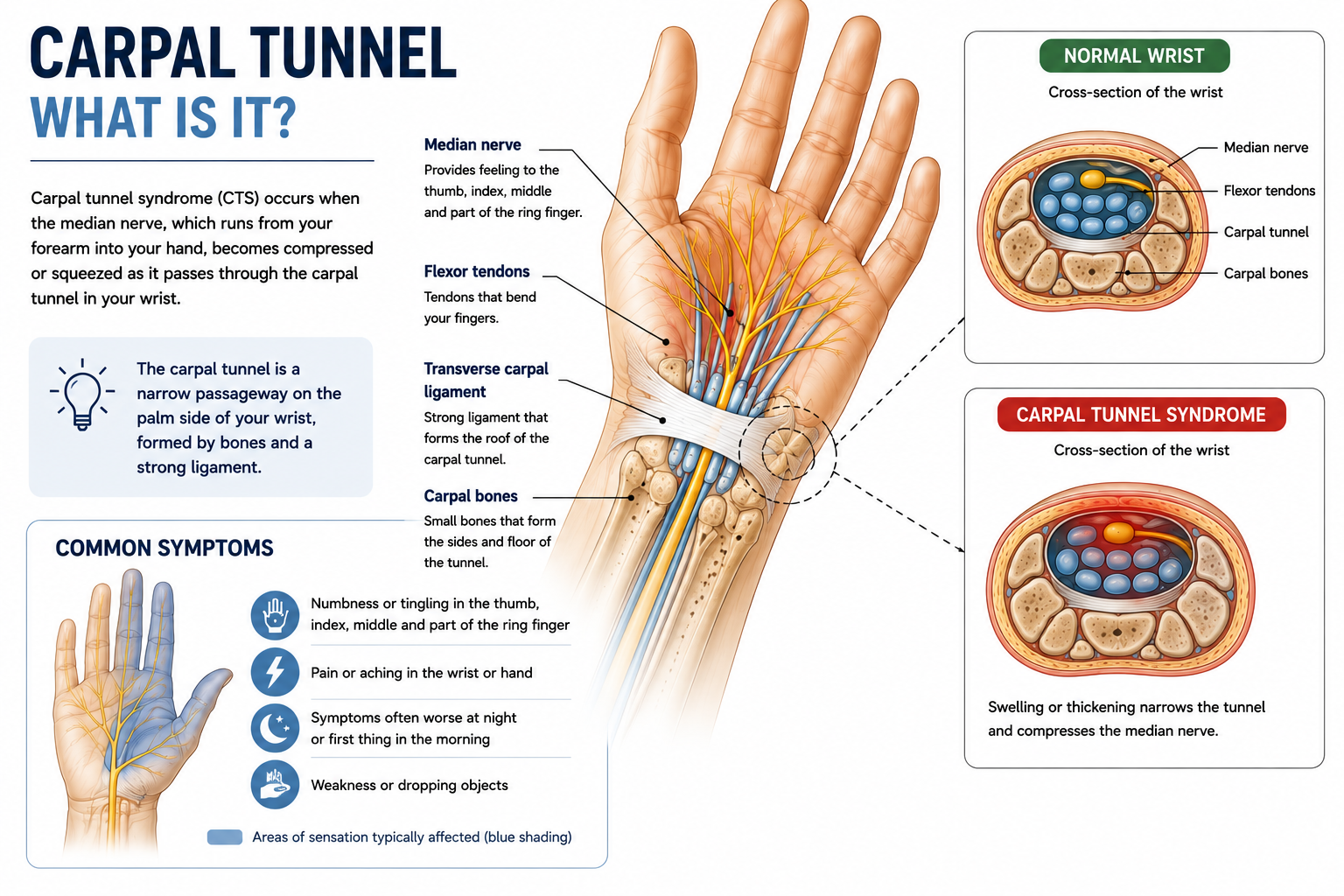
The carpal tunnel is a narrow passageway in your wrist formed by the wrist bones and a strong ligament called the transverse carpal ligament.
Running through this tunnel are:
The median nerve.
Nine flexor tendons that bend your fingers.
When pressure inside this tunnel increases, the median nerve becomes irritated, producing symptoms such as:
Pins and needles in the thumb, index and middle fingers.
Numbness.
Night pain that wakes you from sleep.
Hand weakness.
Difficulty gripping objects.
Dropping items unexpectedly.
It's not just about compression
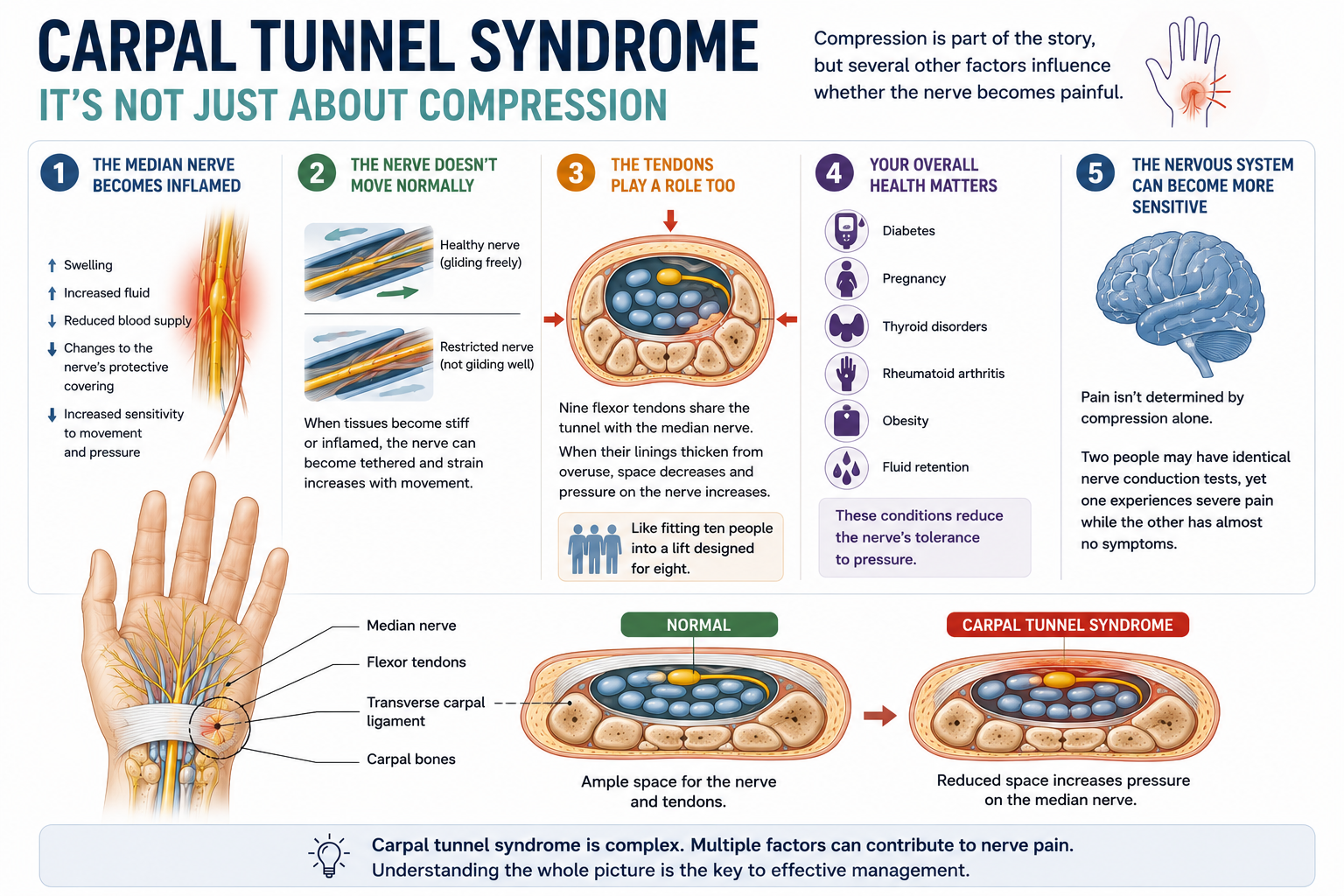
Compression remains the hallmark of carpal tunnel syndrome, but modern research tells us several other factors influence whether the nerve becomes painful.
1. The median nerve becomes inflamed
The median nerve often becomes swollen and inflamed.
Researchers have demonstrated:
Increased fluid within the nerve.
Reduced blood supply.
Changes to the nerve's protective covering.
Increased sensitivity to movement and pressure.
This helps explain why some people have severe symptoms despite only mild changes on nerve conduction studies.
2. The nerve doesn't move normally
Healthy nerves are designed to move.
Every time you bend your fingers or move your wrist, the median nerve should glide smoothly through the carpal tunnel.
When surrounding tissues become stiff or inflamed, the nerve can lose this normal movement and become tethered.
Instead of sliding freely, it experiences greater strain with gripping and wrist movement.
This is one reason carefully prescribed nerve gliding exercises can be so effective for some patients.
3. The tendons play a role too
Nine flexor tendons share the tunnel with the median nerve.
Repetitive gripping, keyboard work, gardening, manual labour and racquet sports can irritate these tendons and cause their linings to thicken.
As space inside the tunnel decreases, pressure on the nerve increases.
Think of it like trying to fit ten people into a lift designed for eight.
4. Your overall health matters
Some nerves are simply more vulnerable than others.
Conditions associated with carpal tunnel syndrome include:
Diabetes.
Pregnancy.
Thyroid disorders.
Rheumatoid arthritis.
Obesity.
Fluid retention.
These conditions reduce the nerve's tolerance to pressure.
5. The nervous system can become more sensitive
Pain isn't determined by compression alone.
Two people may have identical nerve conduction tests, yet one experiences severe pain while the other has almost no symptoms.
Researchers now understand that, particularly in long-standing cases, the nervous system itself can become more sensitive, amplifying pain signals.
A patient who changed my thinking
I'll be honest—earlier in my career, I tended to think that many people with carpal tunnel syndrome would eventually need surgery.
Surgery certainly remains an excellent option for people with significant nerve compression, muscle weakness or symptoms that fail to improve with appropriate conservative treatment.
However, one recent patient genuinely changed my perspective on what physiotherapy can achieve.
She came to Bacchus Marsh Physiotherapy after months of increasing symptoms. She was waking several times every night with numbness and pins and needles in her hand. Driving, using her phone and gripping everyday objects frequently brought on tingling and discomfort.
She was understandably concerned that surgery would be inevitable.
Following a thorough assessment, we developed a treatment program that focused on reducing irritation around the median nerve and restoring its normal movement.
Her rehabilitation included:
Gentle wrist mobility and stretching exercises.
Median nerve gliding exercises.
Education about wrist positioning during daily activities.
Advice on modifying activities that aggravated her symptoms.
Massage wrist flexor muscles
Voltaren gel
Wrist split at night
Over the following weeks, her symptoms steadily improved.
Today, she no longer wakes at night because of her hand.
The pins and needles that were once constant are now only intermittent, and she rates them at just 2/10.
Her symptoms are now so manageable that she no longer requires physiotherapy and confidently manages them herself with the exercises she has learned.
The smile on her face when she realised she wasn't being woken every night—and that surgery was no longer being considered—was incredibly rewarding.
Her recovery reminded me that surgery is not the only answer for everyone with carpal tunnel syndrome.
When assessed early and managed appropriately, many people can make significant improvements with physiotherapy. Of course, surgery still has an important place and can be the best option for people with severe or progressive nerve compression, but this experience reinforced the importance of giving conservative treatment the opportunity to succeed when appropriate.
How is carpal tunnel syndrome diagnosed?
A thorough assessment involves much more than asking where your fingers are numb.
At Bacchus Marsh Physiotherapy we assess:
Your pattern of symptoms.
Grip strength.
Thumb muscle strength.
Sensation.
Wrist movement.
Neural tension tests.
Work, hobbies and sporting activities.
If symptoms are severe or persistent, your doctor may recommend:
Nerve conduction studies.
Ultrasound.
Occasionally MRI.
Modern treatment is about more than just the wrist
Successful treatment often involves addressing several contributing factors.
Treatment may include:
Education about your condition.
Wrist splinting, particularly at night.
Activity modification.
Median nerve gliding exercises.
Tendon gliding exercises.
Wrist mobility and stretching.
Progressive strengthening.
Ergonomic advice.
Addressing underlying medical conditions where appropriate.
If symptoms continue despite appropriate conservative treatment, corticosteroid injections or surgical release may be recommended. Surgery remains a highly successful treatment when there is significant ongoing nerve compression.
The good news
The vast majority of people with carpal tunnel syndrome do not need to simply "live with it."
Many people improve significantly with early diagnosis and the right treatment plan.
The longer severe compression continues, however, the greater the risk of permanent nerve damage.
If you're waking at night with numbness, dropping objects, or experiencing persistent pins and needles, don't ignore the symptoms.
Early assessment can often prevent the condition progressing and may help you avoid more invasive treatment.
Need help with hand numbness or pins and needles?
At Bacchus Marsh Physiotherapy, we provide comprehensive assessment and evidence-based treatment for carpal tunnel syndrome.
Rather than focusing only on the wrist, we look at the whole picture to understand why your symptoms have developed and tailor treatment to your individual needs.
If you're experiencing numbness, tingling or hand weakness, we'd love to help you get back to sleeping through the night, working comfortably and using your hand with confidence.
