
Can My Disc Bulge Go Back In????
Can a Disc Bulge Heal Naturally?
What the Latest Research Says About Disc Herniations
"An MRI is a snapshot in time—not a prediction of your future."
One of the most common questions I hear is:
"I've got a disc bulge. Will I always have it?"
Years ago, many people believed that once a disc herniated, it simply stayed there forever unless it was surgically removed.
Thankfully, research over the last decade has completely changed our understanding.
We now know that many lumbar disc herniations shrink naturally over time. In fact, your immune system actively recognises, breaks down and removes the herniated disc material. Recent reviews published in 2026 bring together decades of research and explain how this remarkable healing process occurs.
Your Body Has Its Own Clean-Up Crew
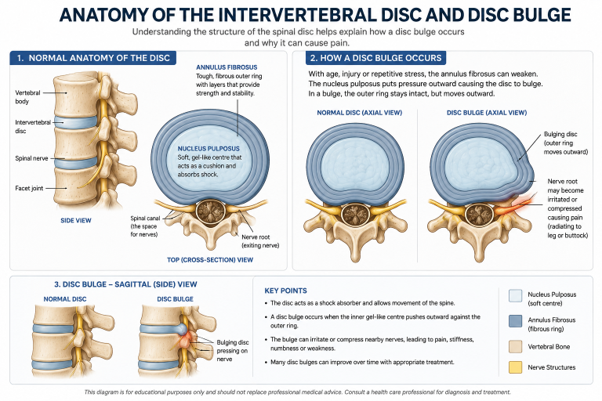
The intervertebral disc is a unique structure.
Unlike most tissues in the body, it has almost no blood supply and is normally hidden from your immune system.
When a disc tears and some of its soft centre (the nucleus pulposus) escapes, something fascinating happens.
Your immune system suddenly recognises that tissue as being in the wrong place.
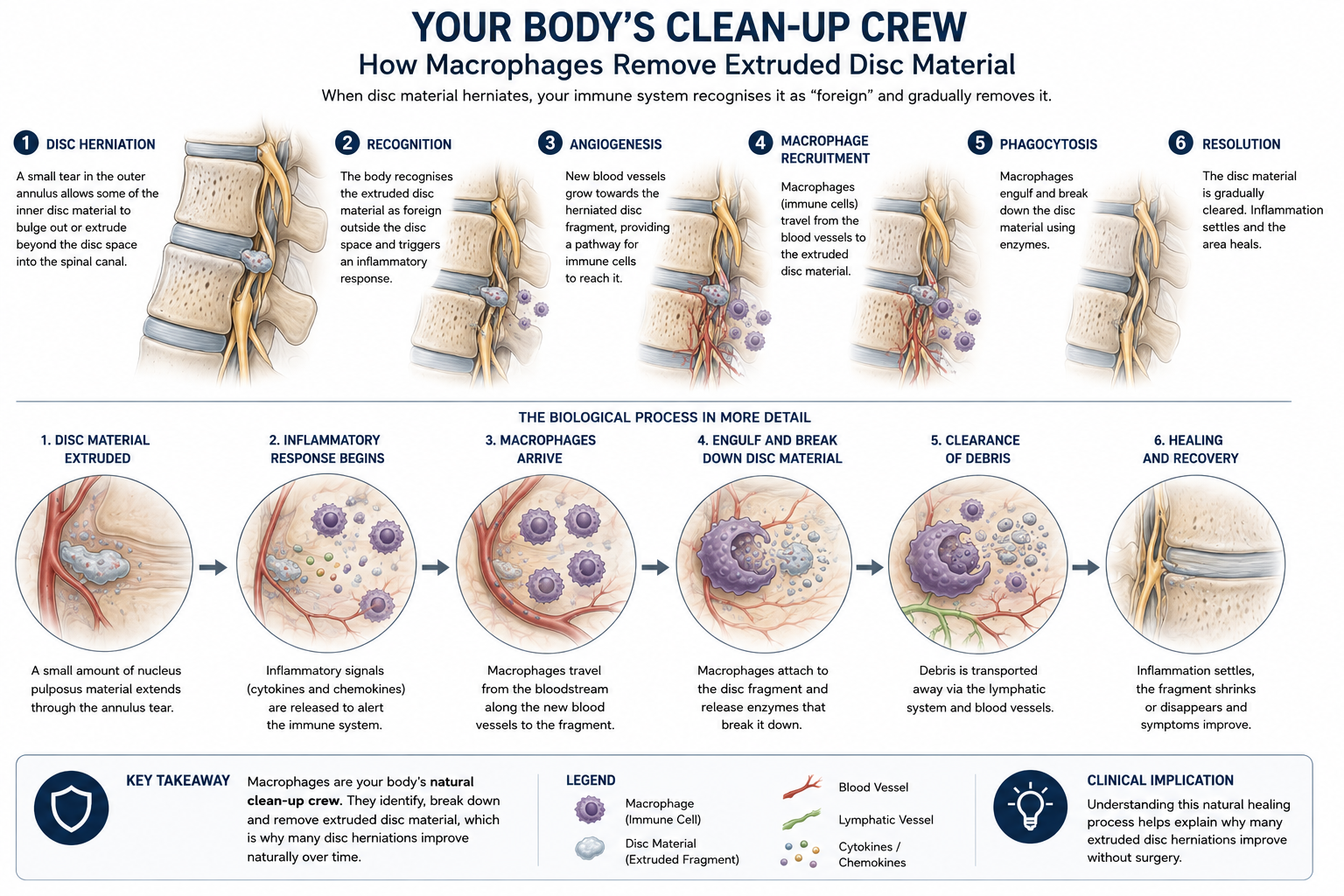
It responds by sending specialised immune cells called macrophages to remove it.
Think of macrophages as your body's demolition and clean-up crew.
They:
surround the herniated fragment
digest damaged tissue
remove dead cells
release enzymes that dissolve the disc
coordinate the healing process
Rather than the disc simply drying out, the body is actively removing it.
Why Inflammation Isn't Always the Enemy
Most people think inflammation is something we should always try to eliminate.
The latest research suggests it's more complicated than that.
Inflammation certainly contributes to pain.
But it also triggers the healing response needed for disc resorption.
Without inflammation:
macrophages don't arrive
new blood vessels don't grow
enzymes aren't released
the disc fragment cannot be cleared efficiently
The researchers describe inflammation as a double-edged sword—too much inflammation can cause pain, but too little may slow the body's natural healing response.
This is why researchers are now questioning whether aggressively suppressing inflammation immediately after a disc herniation is always the best strategy. The evidence is still evolving, so current treatments should not be changed solely on this basis.
Bigger Disc Bulges Often Heal Better
This surprises almost every patient.
Many people assume:
Big MRI = Big problem
Research actually shows something different.
Large extruded and sequestered disc herniations have the highest chance of shrinking naturally.
Approximate spontaneous regression rates are:
Disc protrusion: 52%
Disc extrusion: 70%
Disc sequestration: 93%
Why?
Because the escaped disc fragment is fully exposed to your immune system.
It becomes much easier for macrophages to recognise and remove it.
Ironically, the scariest-looking MRI often has the greatest potential for natural healing.
Blood Vessels Help the Healing Process
Normally, discs have almost no blood supply.
Following a herniation, tiny new blood vessels grow into the disc fragment.
These vessels act like roads that allow macrophages to reach the damaged tissue.
No blood vessels...
No clean-up crew.
This process of neovascularisation is now recognised as one of the most important reasons disc herniations can shrink over time.
Your Body Literally Digests the Disc
Macrophages don't just surround the fragment.
They release specialised enzymes called matrix metalloproteinases (MMPs).
These enzymes slowly dissolve:
collagen
proteoglycans
damaged disc tissue
At the same time:
dead disc cells are removed
water leaves the fragment
the disc gradually becomes smaller
Over months, pressure on the irritated nerve often decreases significantly.
Recovery Takes Time
One of the biggest challenges for patients is patience.
Disc healing happens over months—not days.
Many studies show substantial shrinkage occurs over 3–12 months, with symptoms often improving well before MRI scans show obvious changes.
Just because your MRI hasn't changed yet doesn't mean your body isn't healing.
What Helps Recovery?
Although no treatment has been proven to directly "make" a disc disappear, research consistently supports conservative management for most people.
This includes:
staying as active as symptoms allow
guided physiotherapy
progressive strengthening
walking
gradually returning to normal activities
Exercise also appears to be associated with healthier discs and improved long-term spinal health. Tai Chi and yoga have been shown to improve pain and disability in people with lumbar disc herniation.
What About Anti-inflammatory Medication?
This is one of the most interesting areas of current research.
Because inflammation helps initiate disc resorption, some scientists have questioned whether suppressing inflammation too early could slow the body's clean-up process.
Animal studies suggest steroids can reduce disc resorption, and one clinical study found complete disc regression in patients who avoided anti-inflammatory medication. However, other human studies have not shown the same effect.
So where does that leave us?
At the moment, we cannot conclude that anti-inflammatory medications should be avoided.
They still provide important pain relief for many people.
The research simply reminds us that inflammation has both harmful and helpful roles.
Future studies will hopefully identify the best timing and use of these medications.
When Is Surgery Still Necessary?
Not every disc herniation should be treated conservatively.
Surgery remains essential if there is:
progressive muscle weakness
bowel or bladder dysfunction (cauda equina syndrome)
severe neurological deterioration
persistent disabling symptoms despite appropriate rehabilitation
For everyone else, giving the body an opportunity to heal naturally is often appropriate.
My Thoughts as a Physiotherapist
One of the reasons I enjoy treating people with sciatica is because I've experienced disc-related back pain myself.
Like many patients, I wondered whether my back would ever recover.
What I've learnt—both personally and professionally—is that the body has an incredible capacity to heal when given time and the right rehabilitation.
That doesn't mean ignoring pain.
It means understanding that an MRI is only one piece of the puzzle.
I've seen patients with frightening MRI reports return to work, return to sport and get back to living life without surgery.
The science now explains why.
The Bottom Line
Modern research has changed the way we think about disc herniations.
Many disc bulges don't simply "stay there."
They are actively removed by your body's own immune system through a carefully coordinated healing process involving inflammation, macrophages, new blood vessel growth and tissue remodelling.
Large disc herniations often have the greatest chance of natural regression, and most people improve with well-managed conservative care.
If you've recently been told you have a disc bulge or sciatica, don't let an MRI report convince you that surgery is inevitable.
With the right assessment, education and rehabilitation, many people recover remarkably well.
Need Help with Sciatica or a Disc Bulge?
At Bacchus Marsh Physiotherapy, we take the time to explain what your scan really means, identify whether conservative treatment is appropriate, and guide you through an evidence-based rehabilitation program designed to help you return to work, sport and everyday life with confidence.
Book an appointment today and let's help you understand your back—not fear it
References
Golubović J, Jelača B, Rodić D, Torbica S, Stošić S, Đilvesi Đ. Spontaneous Resorption of Lumbar Disc Herniation: A Narrative Review of Pathophysiology, Predictive Factors, and Clinical Decision-Making. NeuroSci. 2026;7(2):30. doi:10.3390/neurosci7020030.
Cunha C, Yang H, Buser Z, Rojas C, Cunha M, Pereira P, Han IH, Jin L, Li X; AO Spine Knowledge Forum Degenerative. Lumbar Disc Herniation Resorption: When and How Does It Occur? Neurospine. 2026;23(1):82–93. doi:10.14245/ns.2551538.769.
